Metal Egg Tray Drying Machine: How It Works & How to Choose
If you have researched egg tray production lines for more than ten minutes, you have already met the three classic drying options: sun drying, brick kiln drying, and the enclosed metal box dryer. Among buyers who plan to run a serious, continuous operation, one option comes up again and again: the metal egg tray drying machine.
This guide explains exactly what this equipment is, how it works inside, what components you are actually paying for, and how to match a model to your capacity target — using real production-line data from 1,500 to 7,000 pieces per hour, not marketing numbers.
Quick answer: a metal egg tray drying machine is an insulated steel drying box (typically 21–34 m long for full lines) in which wet egg trays travel on chain-driven trays through a 180–200 °C hot-air zone heated by a 0.35–1.9 million kcal gas or diesel burner. It dries trays in roughly 20–35 minutes regardless of weather, with drying quality that does not depend on sunshine or on the quality of local civil works.
1. What Exactly Is a Metal Egg Tray Drying Machine?
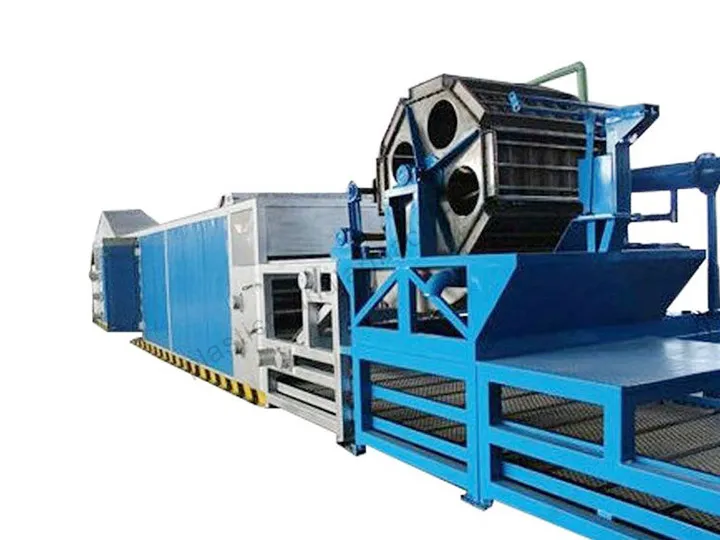
A metal egg tray dryer of this type (often called a multi-layer metal egg tray dryer or metal box egg tray dryer) is a factory-built drying enclosure made of galvanized steel panels with rock-wool insulation. Inside the box, wet trays ride on trays carried by chains through several temperature zones; hot air from a burner is circulated by fans and distributed evenly by perforated air-equalizing plates.
Three things distinguish it from the alternatives:
- It is delivered as equipment, not construction. A brick kiln is a building your local contractor has to build well. A metal dryer is manufactured, inspected, and shipped to you in containers — what you see in the factory is what you get.
- It is fully automatic. Trays exit the forming machine, drop onto the infeed conveyor, and travel through the box continuously. No manual loading, no rack trolleys, no batch timing.
- It is weather-proof and compact. The whole drying section fits inside your workshop (a typical line needs a dry section about 21–34 m long, 2.2–2.6 m wide, 2.4–2.6 m high), so rain, humidity, and dust never touch your product.
That is why for export projects — Africa, Southeast Asia, South America — the metal dryer has become the default choice for lines above roughly 1,500 pcs/h.
2. How It Works: From Wet Tray to Dry Tray in One Pass
The process inside the box is a straight line, and understanding it will help you read any supplier’s quotation:
Four subsystems do the work:
Heating. A pressure burner (natural gas or diesel) injects hot gas into the circulation loop. Burner size scales with capacity: small lines run a 350,000 kcal unit, mid-size lines 900,000–1.3 million kcal, and the largest 7,000 pcs/h lines a 1.9 million kcal burner. This is the single biggest running cost, so fuel choice (gas vs diesel availability and price in your country) deserves a careful look before you order.
Air circulation. Centrifugal fans push hot air across the trays, and air-equalizing plates (perforated steel sheets, typically 1 m × 2 m, 1.2 mm thick with φ20 mm holes) spread the flow evenly across the box cross-section. Weak air distribution — not weak heating — is the real cause of “dry outside, wet inside” trays, so fan count and plate design are worth checking in any quote.
Conveying. Inside the box, trays ride on steel tray carriers moved by chains (chain + tray structure), synchronized with the forming machine. Because the dryer and former run at the same rhythm, there is no buffer of wet trays and no operator needed at the dryer.
Moisture exhaust. Wet air must leave the box as fast as evaporation adds moisture. Exhaust fans run continuously; on batch-style box dryers, a dedicated 0.75 kW exhaust fan handles this. Skimp here and the recirculating humid air will cap your drying speed no matter how big the burner is.
3. Real Specifications: What Each Model Looks Like
Below is a consolidated view of a typical multi-layer metal egg tray drying machine range, based on actual production-line configuration sheets. Capacities are pieces per hour of standard 30-cell egg trays; paper consumption tells you how much waste paper the line recycles per hour.
| Modelo | Capacidad | Total line power | Paper usage | Dryer box size | Burner (gas/diesel) | Drying floor area |
| ET-1500 | 1,500 pcs/h | 75 kW | 150 kg/h | 21.5 × 2.2 × 2.4 m | 0.9M kcal | ≥40 m long bay |
| ET-2500 | 2,500 pcs/h | 122 kW | 250 kg/h | ~22 × 2.2 × 2.4 m | 1.3M kcal | ≥40 m |
| ET-3000 | 3,000 pcs/h | 122 kW | 300 kg/h | ~22 × 2.2 × 2.4 m | 1.3M kcal | ≥40 m |
| ET-4500 | 4,500 pcs/h | 148 kW | 450 kg/h | ~28 × 2.4 × 2.6 m | 1.5M kcal | ≥50 m |
| ET-5000 | 5,000 pcs/h | 210 kW | 550 kg/h | ~28 × 2.4 × 2.6 m | 1.5M kcal | ≥50 m |
| ET-7000 | 7,000 pcs/h | 265 kW | 700 kg/h | ~34 × 2.4 × 2.6 m | 1.9M kcal | ≥50 m × 15 m |
A few observations that matter for your investment:
- The dryer box is the anchor of the whole line. Workshop length (40–50 m for the drying bay, 6 m headroom) is dictated by the dryer, not by the former. Check your building before you check prices.
- Power grows slower than capacity. Going from 1,500 to 4,500 pcs/h triples output but only doubles electrical load (75 → 148 kW), because most of the extra drying comes from a longer box and a bigger burner, not from motors.
- Every unit runs with 4–6 operators total across pulping, forming, and packing — labor cost stays nearly flat as capacity grows, which is precisely why automated drying beats yard drying as you scale.
A smaller option also exists: for pilot plants or budgets under ~1,500 pcs/h, a batch-style standard drying box (9 × 2 × 2.35 m, 350,000 kcal gas/diesel burner, 20 galvanized rack trolleys, 600 mesh sheets) delivers metal-box drying quality at the lowest entry price. The trade-off is manual loading of trolleys and batch cycles instead of continuous flow.
4. Metal Box vs Brick Kiln vs Sun Drying: The Short Version
We cover this decision in depth in our complete egg tray drying system guide, so here is just the part relevant to choosing metal:
| Factor | Metal box dryer | Brick kiln | Sun drying |
| Drying time | 20–35 min, continuous | 25–40 min, continuous or batch | 1–3 days, weather-dependent |
| Civil works needed | None (delivered complete) | Kiln shell, firebox, chimney built locally | Large paved yard |
| Rainy season impact | None | None | Output can drop 30%+ |
| Labor at dryer | None (automatic) | Low–medium | High (flip & move trays) |
| Product consistency | Highest | Good (depends on build quality) | Variable; mold risk in humid climates |
| Investment level | Highest of the three | Medium | Lowest |
The pattern is simple: sun drying is fine for validating a market with 1,000 pcs/h or less in a dry climate; brick kilns suit buyers with cheap local construction and gas; the metal egg tray drying machine wins wherever reliability, food-grade cleanliness, and unmanned operation matter — which describes most export-oriented egg tray businesses.
5. What You Are Actually Paying For: Components Checklist
When quotes from different suppliers differ by 20%, the difference is usually hiding in this list. A complete metal dryer package should include:
- Insulated box body — galvanized inner/outer sheets, 8 cm rock-wool core
- Burner + air ring — sized to the model (0.35M–1.9M kcal)
- Circulation fans and exhaust fans with weather-tight motors
- Air-equalizing plates (perforated, full cross-section coverage)
- Chain and tray conveyor system with drive units
- Infeed mesh belt synchronized with the forming machine
- Observation windows along the box (e.g., 7–11 windows, 1.44 × 1 m) — more windows make troubleshooting and training much easier
- Automatic stacker/collector with cylinder and sensor counting
- Support frames (heavy-duty, ~20 t rating each) and control cabinet with temperature display and VFD speed control
Ask any supplier to state each of these line by line. “Dryer included” is not a specification.
6. Fuel Consumption and Running Cost
The burner is the dominant running cost of an egg tray drying machine. Ballpark logic you can use before requesting a quotation:
- Evaporating the water from 150–700 kg/h of paper input calls for burners of 0.9–1.9 million kcal/h at full fire. As a planning figure, 1 m³ of natural gas delivers about 10,000 kcal, so a 900,000 kcal burner at full fire draws roughly 90 m³/h of gas — in practice it modulates to 60–80% of that after warm-up.
- On diesel, plan with roughly 0.08–0.1 liters per 1,000 kcal of delivered heat.
- Where grid electricity is cheap but gas is scarce, some buyers ask about electric heating. Above roughly 300,000 kcal equivalent, electric elements usually lose to gas on running cost, which is why gas or diesel remains the default fuel for these dryers.
Your real number depends on local fuel prices — send us your gas and diesel prices and we will run the comparison for your specific model.
7. How to Choose the Right Model in 4 Steps
- Fix your target output, not your dream output. If local egg farms consume 2,000 trays a day, a 7,000 pcs/h line runs two hours a day and never pays back. Match the dryer size to verified demand — our capacity selection guide walks through this with real examples.
- Measure the building. You need a straight drying bay of 40–50 m, 6 m headroom, and about 1,000 m² of total workshop for a full line. Container access matters too: the box ships in sections, so plan the unloading path.
- Pick the fuel you can actually buy. Natural gas gives the cleanest operation and lowest cost where pipelines exist; diesel burns anywhere but costs more per kcal. The same machine switches between them with a burner change.
- Check the air side, not just the fire side. Ask how many circulation fans and air-equalizing plates the quote includes. Uniform 180–200 °C airflow is what turns “dried” into “uniformly dried, flat, and strong.”
8. FAQ
How long does a metal egg tray dryer take to dry one tray?
Roughly 20–35 minutes from wet forming to ≤10–12% moisture, depending on model length and tray thickness. Because trays flow continuously, the line still outputs finished trays every minute during that time.
Natural gas or diesel — which burner should I choose?
Choose gas where a stable pipeline supply exists: it is cheaper per kcal and cleaner. Choose diesel where gas infrastructure is unreliable. Burner swap kits make it possible to start on one fuel and convert later.
Can I install a metal egg tray drying machine outdoors?
The box itself is weather-resistant, but we recommend installing it inside the workshop — it shares its infeed conveyor with the forming machine, and operators need access to the stacker and control cabinet anyway.
What maintenance does it need?
Daily: check exhaust airflow and drain condensate. Weekly: inspect chain tension and tray carriers. Monthly: clean air-equalizing plates and fan impellers. Burner service follows the burner manufacturer’s schedule. Most items are simple mechanical work your electrician and fitter can handle after commissioning training.
Does metal drying affect tray quality compared with sun drying?
Positively. Constant temperature and airflow give consistent flatness and strength, and the enclosed box keeps dust, insects, and bird droppings away from a food-contact-adjacent product — a point your egg-farm customers care about.
How much does a metal egg tray dryer cost?
Price scales with capacity and fuel configuration. For a current quotation matched to your target capacity and local fuel prices, send us your requirements — we reply with a line layout and itemized configuration, not just a number.
Ready to Size Your Line?
Tell us your target output, available workshop size, and local fuel prices, and our engineers will return a complete line configuration —máquina de pulpa de papel, egg tray forming machine, metal egg tray drying machine, and packing — with the layout drawn to your building.