Commercial Tire Recycling Line Guide: Choosing Between Semi-Auto, Fully-Auto, and OTR Systems
Every year, an estimated 1.5 billion scrap tires enter the global waste stream. For industrial investors and waste management contractors, this massive volume represents an exceptional commercial opportunity. With virgin rubber prices fluctuating and global green procurement mandates rising, high-purity 10–40 mesh rubber powder, clean tire scrap wire, and textile fibers have established profitable markets in rubberized asphalt, athletic turf infill, molded rubber goods, and steel manufacturing.
However, building a profitable recycling operation begins with one critical decision: selecting the right tire recycling line for your specific raw materials and production scale.
Processing passenger car tires requires a radically different mechanical approach than recycling massive, multi-ton Off-The-Road (OTR) mining tires. Operating an incorrectly configured tire recycling line results in rapid blade chipping, motor overloads, and crippling maintenance downtime.
At EFFICIENT Machinery, we engineer three specialized production platforms: the Semi-Automatic Tire Recycling Line, the Fully Automatic Tire Recycling Line, and the heavy-duty OTR Tire Recycling Line. This engineering guide breaks down process flows, technical specifications, and return on investment (ROI) factors to help you specify the ideal system for your business.
1. Quick Selection Matrix: Which Tire Recycling Line Fits Your Project?
Before exploring machine configurations, match your raw material feedstocks and capital expenditure (CAPEX) against our three industrial systems:
| Technical Parameters | Semi-Automatic Tire Recycling Line | Fully Automatic Tire Recycling Line | Heavy-Duty OTR Tire Recycling Line |
|---|---|---|---|
| Feedstock Dimensions | $\le$ 1,200 mm (Car & Light Van) | $\le$ 1,200 mm (Car, Bus & Heavy Truck) | 1,400 mm to 4,000 mm (Mining & Earthmover) |
| Output Capacity | 200 – 1,000 kg/h (Customizable) | Up to 2,300 kg/h (SL-660 Series) | Multi-ton continuous output |
| Labor Requirement | 2 – 4 manual operators | 1 – 2 monitoring operators | 2 – 3 operators |
| Pre-treatment Method | Manual mechanical cutting | High-pressure hydraulic debeading | Heavy hydraulic shear & rotary slicing |
| Output Purity | >99% pure rubber powder | >99% pure rubber powder | >99% pure rubber powder |
| Target Operation | Startups, pilot plants, small hubs | Commercial recycling plants | Mining contractors, heavy industrial yards |
2. Option 1: Semi-Automatic Tire Recycling Line — Low Investment for Startups
For entrepreneurs launching a crumb rubber enterprise with controlled startup capital, our semi-automatic tire recycling line offers the lowest entry barrier without compromising final product quality.
Instead of utilizing an expensive, high-kilowatt primary shredder, this tire recycling line relies on targeted mechanical pre-cutting to reduce waste tires into uniform pieces before fine grinding.
Step-by-Step Production Process:
- Tire Sidewall Cutting Machine: Shears off the bead ring containing thick steel bundles (capacity: 40 pcs/h; accommodates 650–1,250 mm tires). By isolating the rigid bead wire at the start, subsequent cutters experience far less blade wear.
- 轮胎条切割机: Rapidly slices the de-ringed tire carcass into 3–5 cm wide continuous rubber strips at an output of 1,000 kg/h.
- 轮胎块切割机 (Model QKJ-358): Chops strips into uniform 5×5 cm rubber blocks ready for milling (capacity: 800–1,500 kg/h).
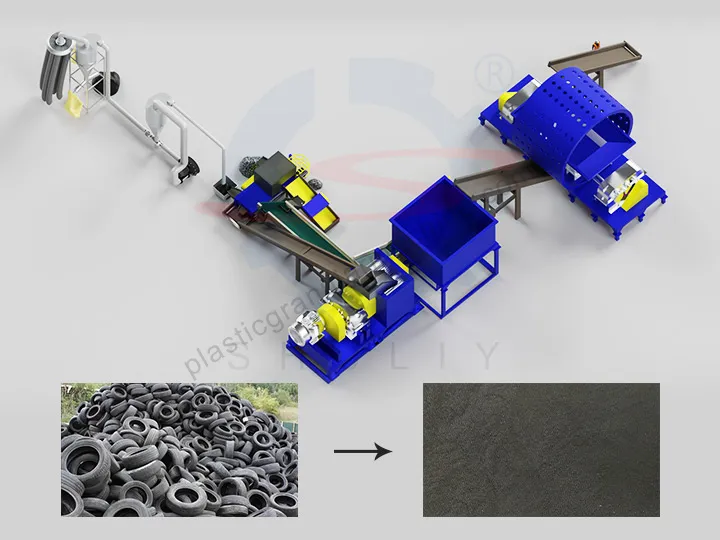
- Grinding, Magnetic Separation & Fiber Removal: Dual-roller mills pulverize rubber blocks down to 10–40 mesh. Integrated magnetic rollers pull out fine steel wire, while an airflow separator purges nylon fluff.
Why Choose This Setup? This entry-level tire recycling line requires only 2 to 4 workers, draws low overall electrical power, and delivers an immediate path to profitability by producing commercial-grade rubber powder with purity exceeding 99%.
3. Option 2: Fully Automatic Tire Recycling Line — High-Efficiency Commercial Production
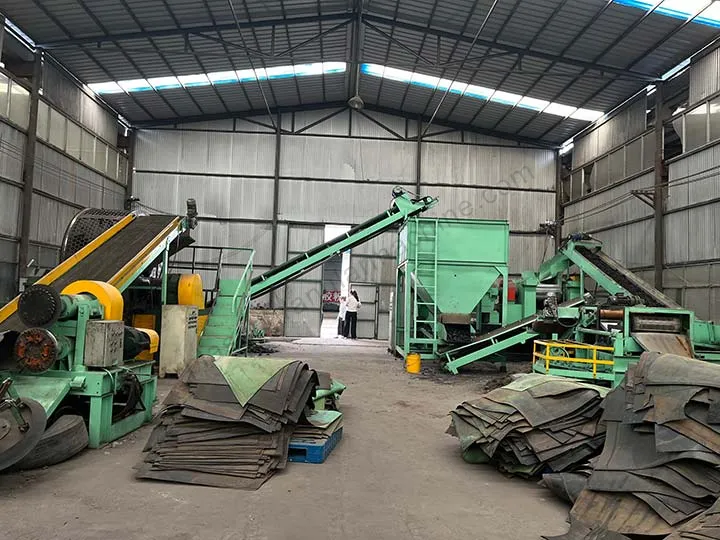
When your business model demands continuous operation, high volume, and minimal labor overhead, our fully automatic tire recycling line is the industry-standard choice.
This integrated plant processes car, bus, and commercial truck tires under 1,200 mm, delivering continuous production throughput of up to 2,300 kg/h.
Core Engineering Modules in This Automatic Tire Recycling Line:
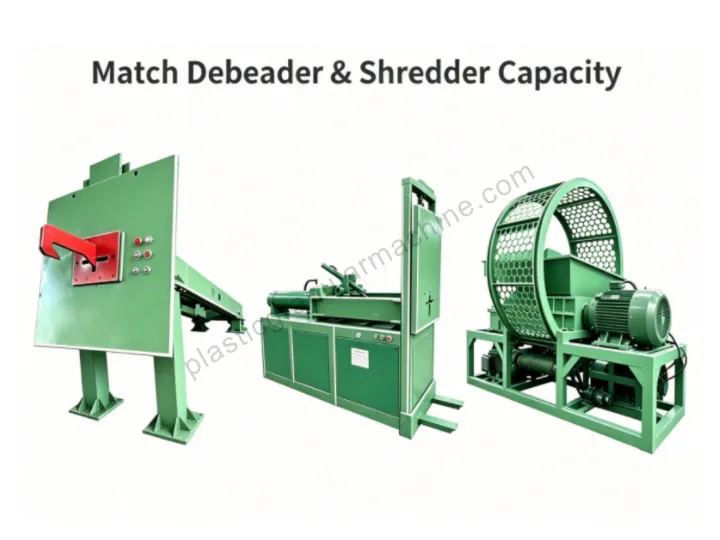
- Hydraulic Tire Debeader (Single/Double Hook): Operating at 20–50 pcs/h, high-tensile hydraulic hooks extract complete steel bead wires from scrap tires. Debeading before shredding triples shredder blade lifespans.
- Heavy-Duty Twin-Shaft Tire Shredder (Models 900 to 1800): Driven by high-torque gearboxes and equipped with Cr12MoV alloy knives, these shredders reduce whole or cut tires into uniform 50–100 mm chips at capacities ranging from 2 t/h to 20 t/h.
- 精度 Rubber Grinding System (SL-Series): From our compact SL-350 to our industrial SL-660 line, dual water-cooled rollers grind rubber granules down to 10–40 mesh without thermal degradation.
- Dual-Stage Magnetic & Airflow Fiber Separation: High-intensity magnetic drums separate steel wire fragments, while a 760 r/min centrifugal fiber separator extracts nylon cords, ensuring over 99% purity in the finished crumb rubber.
Choosing an automated tire recycling line reduces long-term operational payroll, increases plant safety, and delivers steady production volumes for export contracts.
4. Option 3: Heavy-Duty OTR Tire Recycling Line — Solving the Mining Tire Challenge
Tires from haul trucks, front-end loaders, and earthmovers in mining and quarrying environments present unique processing challenges. Measuring from 1,400 mm to over 4,000 mm in diameter, these massive tires stall standard shredders and destroy ordinary blades.
EFFICIENT Machinery manufactures a heavy-duty OTR轮胎回收生产线 engineered specifically to process these multi-ton giants safely and continuously.
Two Proven OTR Processing Configurations:
Configuration 1: Hydraulic Sectioning & Step-Down Shredding:
- OTR Drawing Machine: Clamps and pulls the heavy steel bead wires from giant tires using high-tonnage hydraulic traction.
- OTR Hydraulic Shear: Massive hydraulic blades slice thick tires into manageable rubber segments.
- High-Torque Twin-Shaft Shredder: Crushes dense chunks into 50–100 mm rubber blocks.
- Fine Grinding & Magnetic Purification: Pulverizes rubber into 10–40 mesh powder while extracting all embedded steel cords.
Configuration 2: 3-Axis Rotary Dismantling Plant
- OTR Dismantling Machine: A precision rotary cutter dissects the giant tire into three primary structural sections: the bead rings, the sidewalls, and the thick tread crown.
- OTR Steel Wire Separator: Strips rubber clean from the thick bead ring, generating clean, heavy steel wire ready for smelter recycling.
- Secondary Slicing & Crushing: The tread and sidewalls are sliced and fed into downstream shredders and mills.
5. Technical Spotlight: What Determines the Lifespan of a Tire Recycling Line?
Investing in an overseas tire recycling line requires careful evaluation of build quality, wear parts, and engineering tolerances. Key design advantages built into every EFFICIENT machine include:
- Cr12MoV Alloy Cutting Blades: Primary shredder and cutter blades are forged from vacuum-quenched Cr12MoV tool steel to withstand steel-wire abrasion, extending intervals between blade maintenance.
- Advanced Water-Cooled Grinding Rollers: Friction during fine rubber milling generates heat that can scorch rubber and produce smoke. Our roller mills use integrated internal water-cooling to maintain rubber vulcanization properties and operational safety.
- Purity Exceeding 99% Guaranteed: High-gauss magnetic rollers combined with cyclone airflow separators consistently clean both the rubber powder and recovered steel wire scrap.
- Modular Architecture: Start with an entry-level tire recycling line today; add automated conveyors, secondary shredders, or granulation mills tomorrow as your processing volume expands.
6. Commercial Feasibility: End Products and Revenue Streams
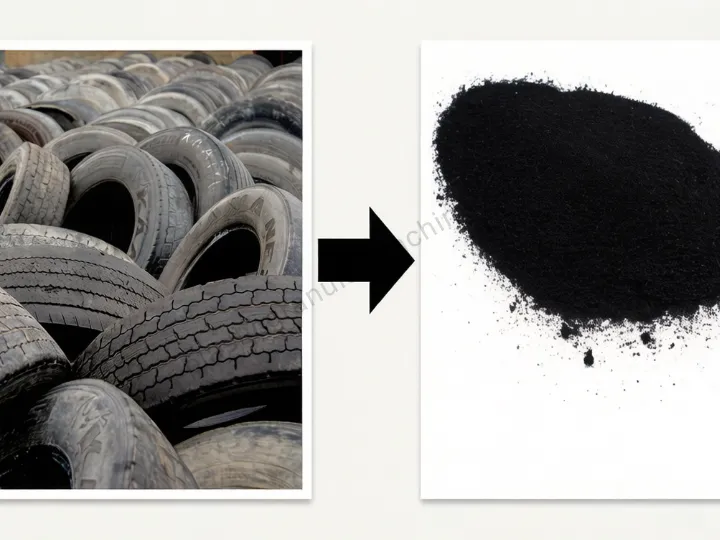
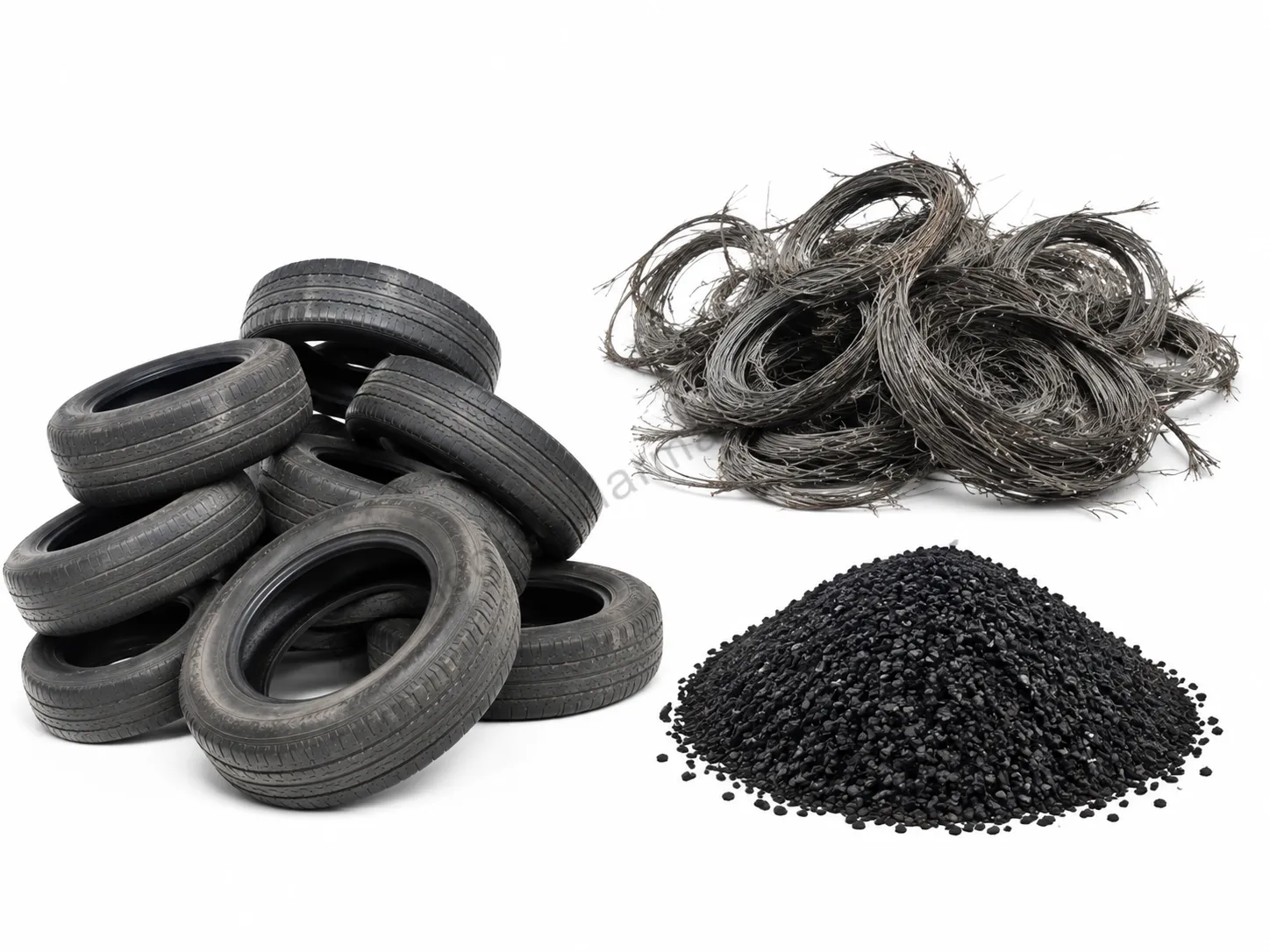
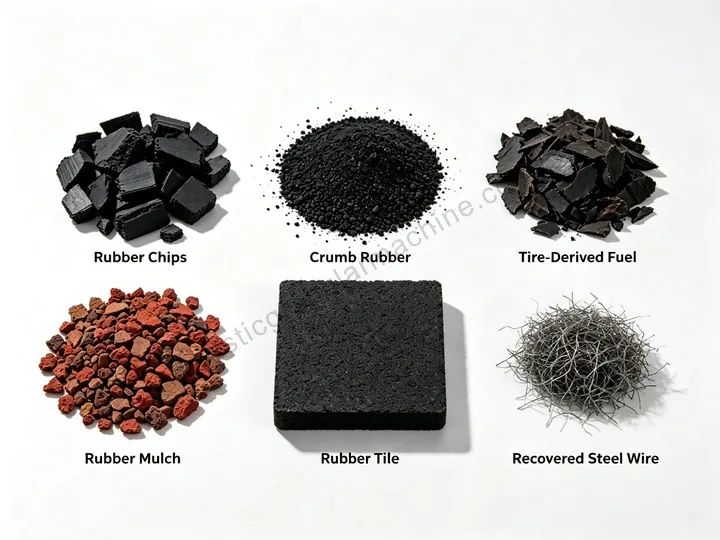
A modern tire recycling line yields three marketable commodities:
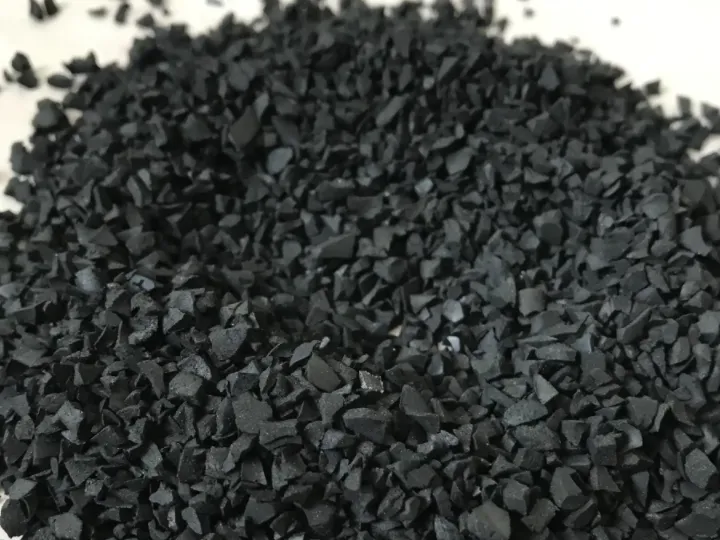
- 10-40 Mesh Rubber Powder (Asphalt, Turf, Molded Goods)
- Clean Steel Wire Scrap (Direct Sale to Steel Mills)
- Clean Nylon/Textile Fiber (Industrial Fuel, Soundproofing)
- 10–40 Mesh Crumb Rubber (Market Share: ~65% of Total Weight):
- 10–20 mesh: Athletic tracks, playground safety tiles, livestock mats.
- 30–40 mesh: Crumb-Rubber Modified Asphalt (CRMA), waterproofing membranes, and reclaimed rubber manufacturing.
- Clean Scrap Steel Wire (Market Share: ~15–25% of Total Weight): High-tensile carbon steel recovered by our tire recycling line commands competitive prices from scrap metal yards and steel smelters.
- Textile Fluff (Market Share: ~5–10% of Total Weight): Used as a high-calorific alternative fuel in cement kilns or as an acoustic insulation additive.
7. Frequently Asked Questions (FAQ)
What factors influence the cost of a complete tire recycling line?
The total investment for a tire recycling line depends on automation level, daily capacity, and incoming tire dimensions. A starter semi-automatic line requires a modest initial budget, while a fully automatic high-output line or a specialized OTR tire recycling line requires higher capital outlay offset by minimal labor costs and high processing volume.
What factory floor space is required for a commercial tire recycling line?
A semi-automatic plant requires roughly 200–400 square meters. A high-capacity, fully automated tire recycling line with raw material staging and finished goods storage typically requires 800–1,500 square meters.
Why is bead wire extraction essential in an automated tire recycling line?
Tire beads contain dense bundles of high-tensile steel wire. Feeding intact beads into a shredder accelerates blade wear and spikes electrical consumption. Removing beads beforehand triples blade lifespans and prevents downtime across your tire recycling line.
Launch Your Project with EFFICIENT Machinery
Whether you require a starter semi-automatic tire recycling line, a 2,300 kg/h fully automatic tire recycling line, or an industrial OTR tire recycling line for mining operations, Zhengzhou Efficient Machinery Co., Ltd. delivers robust equipment, competitive factory-direct pricing, and turnkey overseas support.
Our technical sales engineers will assess your target tire types, desired capacity, and factory dimensions to provide a detailed project proposal.